How to Make Games Solo in 2026: The AI Pipeline, Costs, and Real Limitations
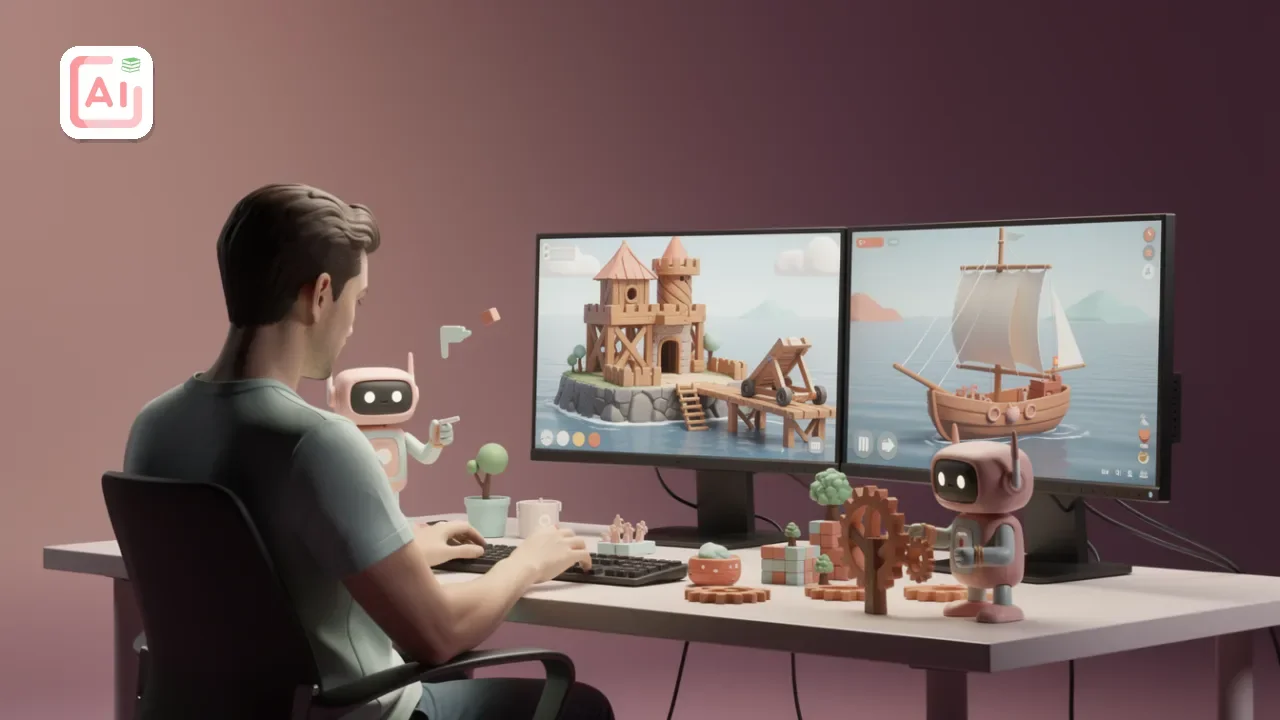
Table of Contents
Developing video games solo (solo gamedev) used to mean either choosing the simplest possible 2D genres or spending years on routine work involving code, 3D models, animations, and networking. By 2026, autonomous AI agents and generative models for 3D, audio, and video had significantly lowered the barrier to entry.
Let’s examine a real-world example—the case study from the Ulbi TV channel—to see how a web developer with no game-industry experience built a playable prototype of a multiplayer medieval survival game in Unreal Engine 5 in 5 days (around 72 hours of actual work).
How the Development Approach Changed with the Arrival of AI Agents
The key difference between 2026 and the early chatbot era is the shift from copying code snippets to orchestrating autonomous AI agents that operate 24/7.
Developers no longer write every line of C++ or every Blueprint manually. Their role has shifted toward that of a systems architect, product manager, and QA tester:
- Architecture and requirements design: creating a clear plan and specifications, and breaking tasks down into modules.
- Structural oversight: tracking dependencies between systems, refactoring, and fixing the neural network’s logical dead ends.
- Integration and polish: assembling finished assets in the engine, configuring physics and balance, and ensuring visual consistency.
The Solo Developer’s Tool Stack and Budget
Creating a 3D multiplayer game solo no longer requires a team consisting of a programmer, 3D artist, animator, and sound designer. A combination of basic free editors and specialized AI services is enough.
| Area | Tools in the Stack | Purpose |
|---|---|---|
| Game engine | Unreal Engine 5 | Scene assembly, physics, networking code, lighting, and rendering |
| Code and logic (C++) | Codex / GPT agents (primary), Claude | Writing game logic, network interactions, and systems without in-depth C++ knowledge |
| 3D modeling | Tripo AI + Blender | Generating 3D models from text/images, followed by manual refinement and optimization |
| Animations | Cascadeur, AccuRIG, Higgsfield, Rokoko | Generating key poses, skeleton rigging, and storyboards for movement |
| Sound and music | ElevenLabs | Generating sound effects (footsteps, impacts, nature sounds) and ambient background audio |
Actual AI-related costs:
- AI coding agents: around $300 per month (3 accounts with $100 limits each, since an agent working around the clock uses up a single account’s limit in 2 days).
- 3D generation (Tripo AI): ~$40–50 for an upgraded plan with a discount.
- Animations, storyboards, and sound (Higgsfield, Rokoko, ElevenLabs): approximately $45 total for basic subscriptions.
In total, an active month of development with agents running 24/7 costs approximately $400 (about $100 for one week of intensive prototyping). That is less than the monthly salary of even a single junior specialist.
What AI Can Already Do on Its Own—and Where Humans Are Still Needed
Even without C++ knowledge, it was possible to implement a complex set of mechanics in 5 days: modular construction from blocks of different tiers (wood, stone, iron), dynamic weather and sea storms, a crafting system, bow ballistics, siege weapons (a battering ram, ballista, and trebuchet with calculated damage radius), ship controls, basic multiplayer, voice chat, guilds, and territory capture.
However, hands-on practice immediately reveals the hard limits of AI capabilities in 2026:
- 3D asset optimization: a neural network can easily generate a beautiful fir tree with 1.5 million polygons. If you scatter trees like that across the map, the game will turn into a slideshow. Retopology and performance control are still the developer’s responsibility.
- Complex animations and rigging: animation generation from video or prompts often produces “jerky” and unnatural movements. Combat, horseback riding, and smooth transitions have to be refined manually in Cascadeur and Blender.
- Equipment fitting: a neural network does not always bind objects correctly to the skeleton’s bones. For example, a torch or weapon may end up not in the character’s hand, but inside the model’s textures.
- Physics and game feel: making a cart or battering ram roll realistically, choosing the correct object weights, and tuning control responsiveness are only possible through manual testing.
Has Development Become Easier, and Can One Person Make a Complex Game?
Development has become significantly faster and cheaper, but it has not turned into a “Create a masterpiece” button.
- Prototyping has accelerated by orders of magnitude. Tasks that once required months of studying engine documentation and writing basic boilerplate—inventory, saving, and network replication—can now be completed in a few days.
- The barrier to entry for coding has fallen, but the demands on systems thinking have increased. You can build a working project without knowing C++, but only if you can think systematically, decompose tasks, understand client-server architecture, and recognize in time when AI starts to “hallucinate” and break neighboring modules.
- A solo developer can create a complex game, but will get stuck on polish. Building an MVP (minimum viable product) with complex mechanics, such as a survival game featuring sieges and multiplayer, is realistic for one person. But turning a rough prototype with awkward animations and physics bugs into a commercial Steam release will require months of manual polish, level design, optimization, and testing.
In 2026, AI has taken most of the routine content-production and coding work off the solo developer’s shoulders, but the roles of game designer, architect, and strict editor still belong entirely to humans.
Read our review of the best AI games to learn how neural networks are already being used inside games themselves—to write stories and control characters.
I study AI not as magic but as a tool. I love order in data and complex systems.