10 Chinese AI Tools That Are Changing the Rules of the Game
Table of Contents
In a world of artificial intelligence where Western models often dominate the media landscape, China is actively building its own ecosystem of advanced solutions—from powerful language models to intuitive creative tools. These technologies do not simply copy their Western counterparts; they offer unique approaches tailored to local needs and scalable for global use. We invite you to explore our ranking of the best Chinese AI tools that can become indispensable assistants for both professionals and everyday users.
1. DeepSeek
DeepSeek is a chatbot and family of language models developed by a Hangzhou-based company. It writes and analyzes text, solves math and programming problems, searches the internet, and reads files. Its key advantage is the Mixture of Experts architecture: only part of the model handles each request, so DeepSeek costs several times less than leading Western models while offering comparable performance. The model weights are open, so you can download and run them locally.
The chatbot is free and works in browsers as well as iOS and Android apps. It handles English well, not just Chinese. The interface is minimalist, similar to ChatGPT. It is particularly useful for researchers and developers, while its API is one of the cheapest on the market. Downsides include possible delays and “server busy” messages during peak hours, as well as censorship of responses on political topics related to China.
2. Quark
Quark from Alibaba has evolved from a simple mobile browser into an AI assistant and search platform powered by Qwen models. Instead of a list of links, users receive structured, context-aware answers generated in real time. The system also offers cloud storage, personalized recommendations, and integration with search history.
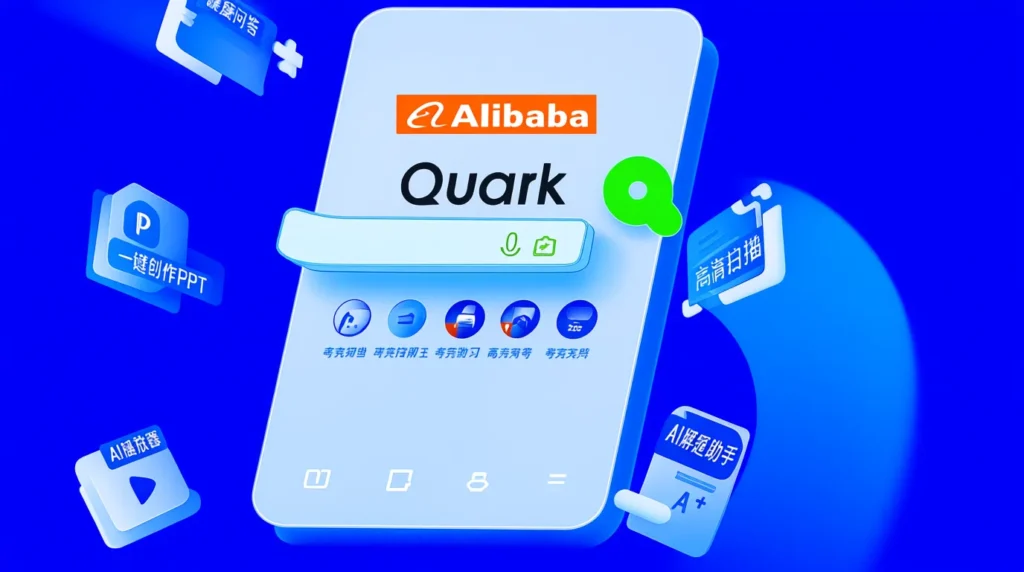
According to industry reviews, more than 100 million people in China use Quark every month. For computers, it is available as an AI browser with an assistant in the side panel. The service is intended for mainland China: the interface is available only in Chinese, and there is no international version.
3. Doubao
Created by ByteDance, the company behind TikTok, Doubao is China’s most popular chatbot, combining text and image generation and even AI video chat in a single app. This makes it an ideal choice for content creators who need to quickly turn ideas into visual assets. Users can upload photos, receive descriptions, create illustrations, or interact with AI through the camera in real time.

The main features are free, but Doubao works only in mainland China: the website is blocked outside the country, and registration requires a Chinese phone number. For the rest of the world, ByteDance offers a separate app called Dola (formerly Cici). Live camera-based interaction raises privacy concerns, which should be taken into account when working with sensitive data.
4. Kimi
Kimi is an AI assistant from Moonshot AI. It became famous for handling extremely long texts: users can upload an entire book or a batch of reports and ask questions about them. Today, it is a universal assistant with an agent, deep research, and tools for creating presentations, documents, and websites.
Kimi works in English and other languages, understands images and files, and offers apps for phones and computers. Models in the Kimi K2 series have been released with open weights. The basic version is free, while the Plus subscription costs $19 per month and provides more agent and research requests.
5. Qwen
Qwen is not merely a language model but a foundation for business solutions within the Alibaba ecosystem. It handles complex multi-step requests, analyzes large volumes of data, and integrates with cloud services, CRMs, and management systems. Businesses use it to automate reporting, forecast demand, and optimize customer service.

For regular users, there is the free Qwen Chat chatbot, which supports text generation, coding, file analysis, and image and video generation. A Chinese phone number is not required for the international version—an email address is enough. Many Qwen models are released with open weights and rank among the most popular open models, while the API through Alibaba Cloud is billed by tokens.
6. Manus AI
Manus AI is an autonomous AI agent created by a team of Chinese origin; the company is now headquartered in Singapore. Unlike a regular chatbot, it does not merely provide answers but independently completes multi-step tasks: searching for and comparing information online, analyzing data, preparing reports and presentations, and creating websites. The user assigns a task and receives a finished result, while the agent’s workflow can be observed. It works in English and other languages, including Russian. Downsides include credit consumption and occasional errors on complex tasks, so the results should be reviewed.

7. CapCut
CapCut from ByteDance has become a global leader by combining remarkable simplicity with powerful AI features. Automatic selection of the best clips, green-screen-free background removal, accurate subtitle generation, and direct TikTok integration make it indispensable for anyone creating content on a smartphone.
It suits both beginners and experienced users, providing professional effects without the need for complex software. The only downsides are that the free version adds a watermark and advanced features require a subscription. It will not replace Premiere Pro for editing full-length films, but for social media, it is the best choice.
8. ZeroGPT
As the use of AI for writing texts has grown, so has the need to verify their authenticity. ZeroGPT is not a Chinese service, but it is included in this selection as a popular tool for checking texts, including those generated by Chinese models such as DeepSeek and Qwen. It estimates the proportion of AI-generated text and highlights suspicious phrases. Teachers, HR professionals, and journalists use it to identify generated work, plagiarism, and fake materials.
The tool is easy to use: simply paste in the text and receive a result. The free version allows users to check up to 15,000 characters at a time. Nevertheless, the result is probabilistic: false positives can occur with human-written texts, while well-edited AI content may go undetected. Therefore, a detector’s assessment is not proof.
9. Remini
Remini transforms blurry, black-and-white, or low-quality photos into sharp, colorful, and lifelike images with remarkable detail. Using deep learning, it restores faces, improves lighting, and recreates the textures of skin, hair, and clothing, as if bringing the past back to life. It is especially popular among families, restorers, and social media users who want to refresh old photos.
The free version limits the number of daily enhancements, while regular use requires a subscription. Strictly speaking, Remini is no longer a Chinese product: since 2022, the app has belonged to the Italian company Bending Spoons. It works online only, but its results often surprise even professionals.
10. Hailuo AI
Hailuo AI from MiniMax turns text descriptions and static images into short cinematic videos. With the current MiniMax H3 model, videos can be generated at up to 2K quality, and a single prompt can include up to 12 references. Users control camera movement directly through the prompt—like a real director—while Hailuo Agent assembles a video from multiple scenes. This makes the service convenient for advertisements, Stories, and viral content.
The short length of individual clips and the need to purchase credits—a subscription starts at $14.99 per month—are the main drawbacks. Nevertheless, no other tool combines this level of speed, control, and creative freedom for mainstream users.
Chinese AI tools demonstrate not only technological power but also a deep understanding of how technology should serve specific tasks—from scientific research to family archives. These tools do not merely replace manual labor; they redefine how we create, search, restore, and express ourselves in the digital world.

I study AI not as magic but as a tool. I love order in data and complex systems.