OpenRouter
No ratings yetOne OpenAI-compatible API key for 600+ models from 80+ providers: GPT, Claude, Gemini, DeepSeek. 25+ free models, no markup on token prices.
- Category
- Infrastructure
- Pricing
- Details on the service site
- Free plan
- Yes
- Platforms
- Web
- Payment
- Bank card, Cryptocurrency
- Access
- API
- Use case
- Multi-LLM chat clients
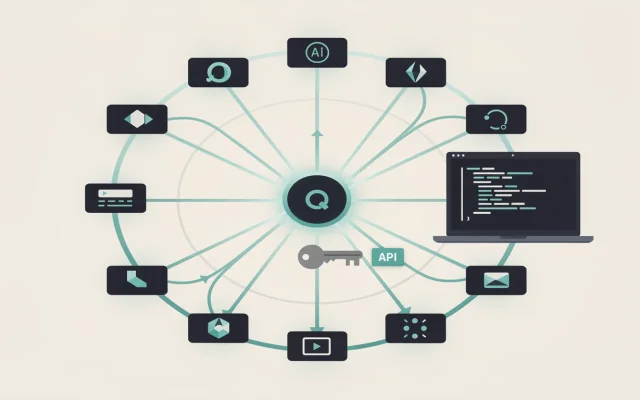
OpenRouter is a service that acts as an intermediary between your application and language model providers. Instead of maintaining separate accounts and API keys for OpenAI, Anthropic, Google, and DeepSeek, you get one key and one balance, while selecting the model by specifying it in the request: openai/..., anthropic/..., deepseek/.... According to the service, more than 600 models from over 80 providers are available through it.
The OpenRouter API is compatible with OpenAI: in any application that supports OpenAI, simply replace the endpoint with https://openrouter.ai/api/v1 and enter your OpenRouter key. That is why the service is supported by n8n, Cursor, Cline, SillyTavern, LibreChat, and many other clients.
Pricing and fees
- There is no markup on models: tokens cost the same as they do from the provider itself.
- The fee is charged when adding funds: 5.5% on the Standard plan (pay-as-you-go, with no subscription fee or minimum commitment). The Business plan, with an 8% fee, adds routing within the EU or US and DPA signing; Enterprise offers custom terms, SSO, and SLA.
- Payment methods: bank cards, AliPay, and USDC cryptocurrency; automatic top-ups are also available. Under the service’s terms, purchased credits may expire one year after purchase.
- Bring Your Own Keys (BYOK): you can connect your own OpenAI, Anthropic, and other provider keys. The first $25,000 of monthly spending (at OpenRouter pricing) is commission-free; beyond that, the fee is 5%.
Free models
Some models have a free version with the :free suffix; more than 25 such models are available on the free plan. Limits:
| Condition | Per minute | Per day |
|---|---|---|
| Fewer than 10 credits purchased | 20 requests | 50 requests |
| 10 or more credits purchased | 20 requests | 1000 requests |
Failed requests also count toward the daily limit, and free models are disabled when the balance is negative. OpenRouter does not impose its own plan-specific limits on paid models; restrictions are set by providers.
What OpenRouter can do
- Fallback providers: if a provider returns an error, the request is automatically sent to the next one; tokens are not charged for failed attempts.
- Automatic model selection:
openrouter/autoselects a model based on the request, whileopenrouter/freeselects a free model. - Routing options: the
:nitrosuffix selects the fastest provider,:floorselects the cheapest one, and:exactoselects providers with reliable tool calling. - Privacy: by default, requests and responses are not stored. In the settings, you can disable providers that store data or use it for training, and enable routing only through providers with Zero Data Retention.
- Prompt caching, budgets, and separate keys for projects are available on paid plans.
Who is it for?
- Those comparing models: switch between Claude, GPT, Gemini, and DeepSeek with a single line, without creating new accounts.
- Agent and automation developers: use one key for all models, with fallback providers in case of outages.
- Those who find it inconvenient to pay for multiple services: use one balance instead of several API subscriptions.
If the lowest possible price for one specific model is important, it is worth getting it directly from the provider: the 5.5% top-up fee is the price of convenience.
How to connect OpenRouter to n8n — for agents, workflows, and the n8n Assistant: Get started with n8n.
Do I need a subscription to use OpenRouter?
No. You pay only for the tokens you use from a pre-funded balance. Free models can be used without adding funds, with a limit of 50 requests per day.
Is OpenRouter more expensive than using a provider’s API directly?
Token prices are the same; the difference is the 5.5% top-up fee on the Standard plan.
Does OpenRouter store my requests?
Not by default. However, the request is still sent to the model provider, which has its own data retention policy. Providers that store data can be disabled in the privacy settings.
Articles about this tool
FAQ
Do I need a VPN or proxy to use the service?
It depends on your region. If the service is not available in your country, its site says so; a VPN or proxy is a way around regional limits, but follow the rules of the service and the laws of your country. How to choose a proxy is covered in our guide to proxies for Claude. The easiest check is to open the service site.
Is it safe to share my data with an AI tool?
Do not enter passwords, payment details, personal data or trade secrets. Many services store requests and may use them to train models, especially on free plans. Check the privacy policy and the settings of the service, where training can often be switched off.
Similar tools
-
41 0
Free package manager with a built-in Inference UI: install ComfyUI, Forge and Fooocus in one click on Windows, Linux and Apple Silicon Macs.
- Editors' choice
- Infrastructure
- Free
- Image generation
- Run AI yourself
-
15 0
Piggy.to is a powerful tool for creating content right on your smartphone.
- Infrastructure
- Image & Design
- Free
- Web design
-
1 0
Open-source desktop app runs LLMs locally offline and serves an OpenAI-compatible API on port 1337. Free, Apache 2.0, Windows, macOS, Linux.
- Infrastructure
- Multi-LLM chat clients
- Run AI yourself
-
1 0
Second Brain lets you index local files—documents, images, PDFs, and other formats—by both name and content.
- Infrastructure
- Q&A over documents
-
Gradio web UI for Stable Diffusion: text-to-image and image-to-image, inpainting, outpainting, upscaling and a large extension library.
- Infrastructure
- Free
- Image generation
- Photo editing
- Run AI yourself
-
Node-based visual workflow editor for AI image generation: build, test and tweak models, parameters and results from a large library of nodes.
- Infrastructure
- Free
- Image generation
- Text to video
- Run AI yourself