Photorestoration
No ratings yetFree online AI photo restoration: repairs scratches, damage and defects in old photos and sharpens blurry details automatically.
- Category
- Image & Design
- Pricing
- Details on the service site
- Free plan
- Yes
- Use case
- Photo editing
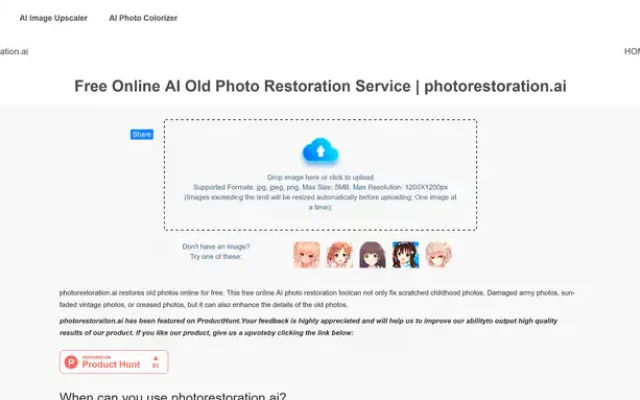
Photorestoration.ai is a free online photo restoration service that uses artificial intelligence to automatically repair damage, scratches, and other defects in photos. It can also enhance details in blurry old photos, creating fresh, new-looking images. You can upload old photos in JPG, JPEG, or PNG format, up to 5 MB in size and with a resolution of no more than 1200 × 1200 pixels.
Choose Photorestoration.ai to restore your precious memories and preserve them for years to come. Whether it’s a childhood portrait, a vintage photo, or a snapshot from a military album, Photorestoration.ai will fix defects in the photo and bring it back to life. Its excellent interface provides users with a professional experience.
FAQ
Do I need a VPN or proxy to use the service?
It depends on your region. If the service is not available in your country, its site says so; a VPN or proxy is a way around regional limits, but follow the rules of the service and the laws of your country. How to choose a proxy is covered in our guide to proxies for Claude. The easiest check is to open the service site.
Is it safe to share my data with an AI tool?
Do not enter passwords, payment details, personal data or trade secrets. Many services store requests and may use them to train models, especially on free plans. Check the privacy policy and the settings of the service, where training can often be switched off.
Similar tools
-
37 0
Open-weights text-to-image model by Stability AI: runs locally on a GPU, LoRA and ControlNet, versions 1.5 to 3.5. Free under $1M annual revenue.
- Editors' choice
- Image & Design
- Free
- Image generation
-
30 0
OpenArt is an AI image generator with a graphics editor: text prompts, sketch-to-image and QR codes. 100 free credits, plans from $7.99 a month.
- Image & Design
- Paid
- Image generation
- Photo editing
-
28 0
Green Screen AI is an interactive, easy-to-use platform for transforming your photos into generative art with artificial intelligence.
- Image & Design
- Photo editing
-
28 0
MakeLogo AI is a powerful AI-powered tool for creating unique logos.
- Image & Design
- Paid
- Logos & branding
-
28 0
An AI tool for planning residential spaces. Access is completely free for regular users.
- Image & Design
- Free
- Architecture
-
27 0
Rostrio (formerly Passphoto) is an AI-powered service for processing personal photos.
- Image & Design
- Photo editing